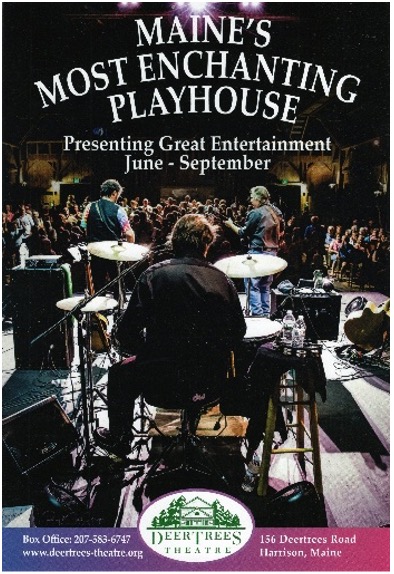
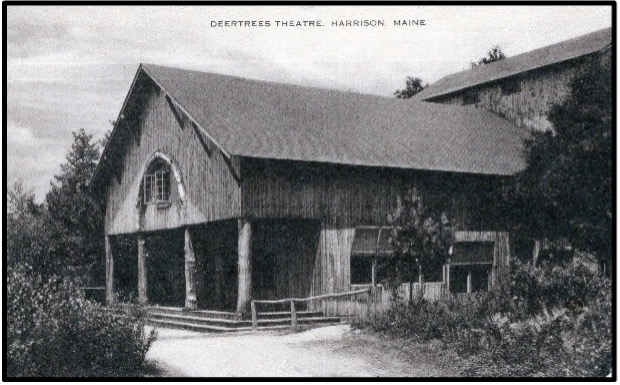
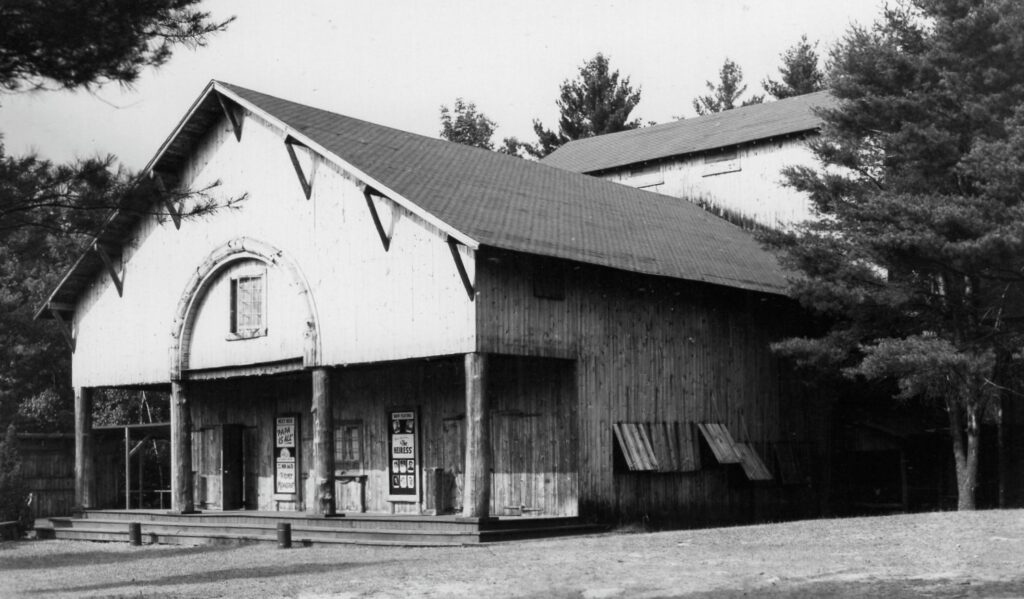
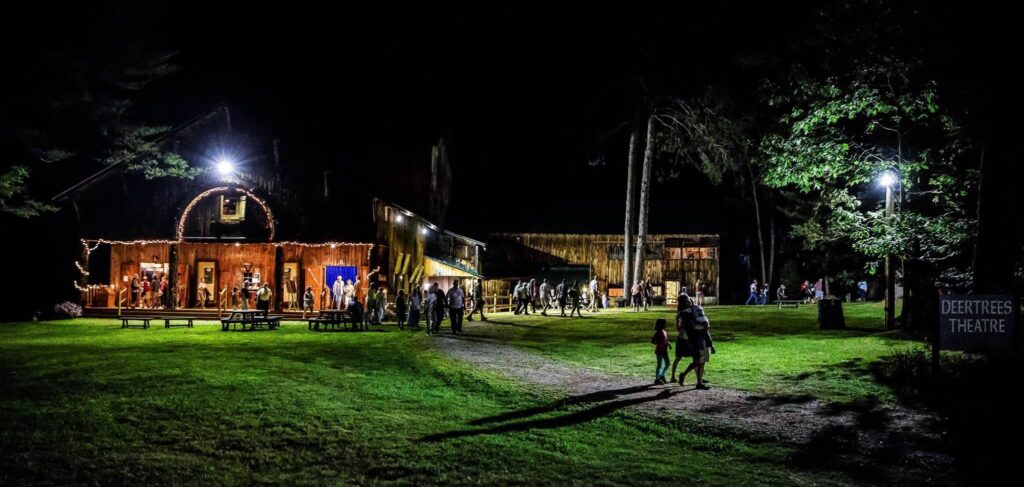
Nestled in the beautiful foothills of Western Maine’s Lake Region is the quaint town of Harrison, Maine. Tucked in its woods is this unique historic Adirondack-style theatre, fondly known as Deertrees. Since its grand opening in 1936, both famous stars and unknown talented performers have graced Deertrees’ stage and looked out into its rustic auditorium, hearing the applause of an appreciative audience.
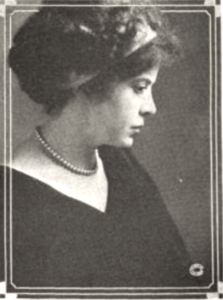
Enrica Clay Dillon - 1912
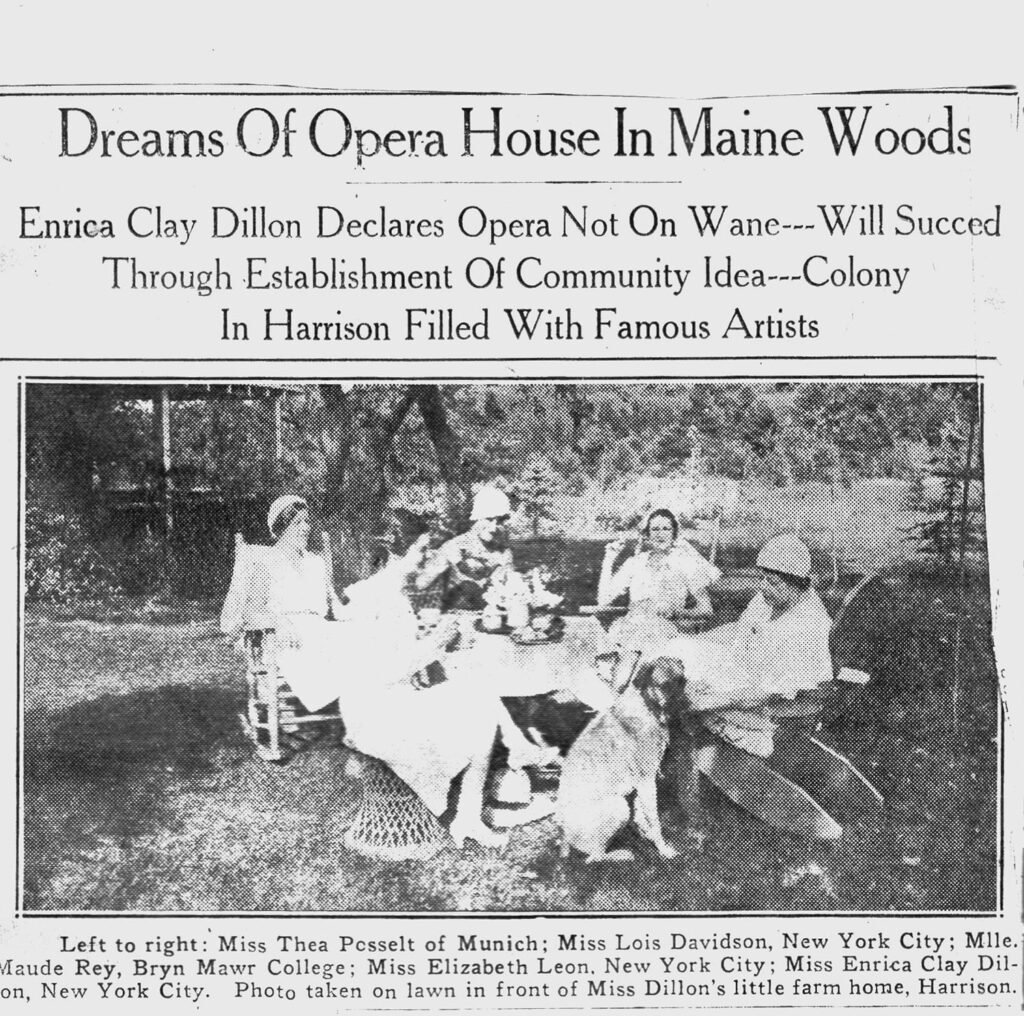
Deertrees Theatre is the “dream child” of Enrica Clay Dillon, a successful New York drama coach for grand and light opera who had become a member of Harrison’s music colony during the summer of 1916.
Portland Sunday Telegram September 27, 1931
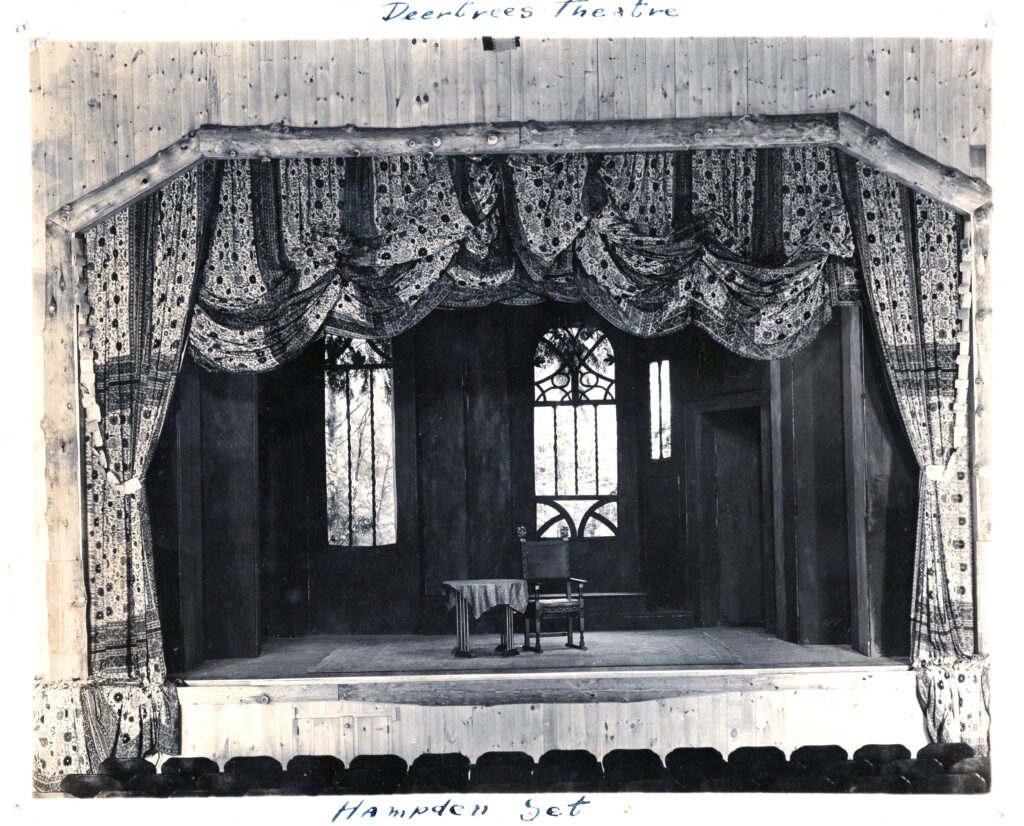
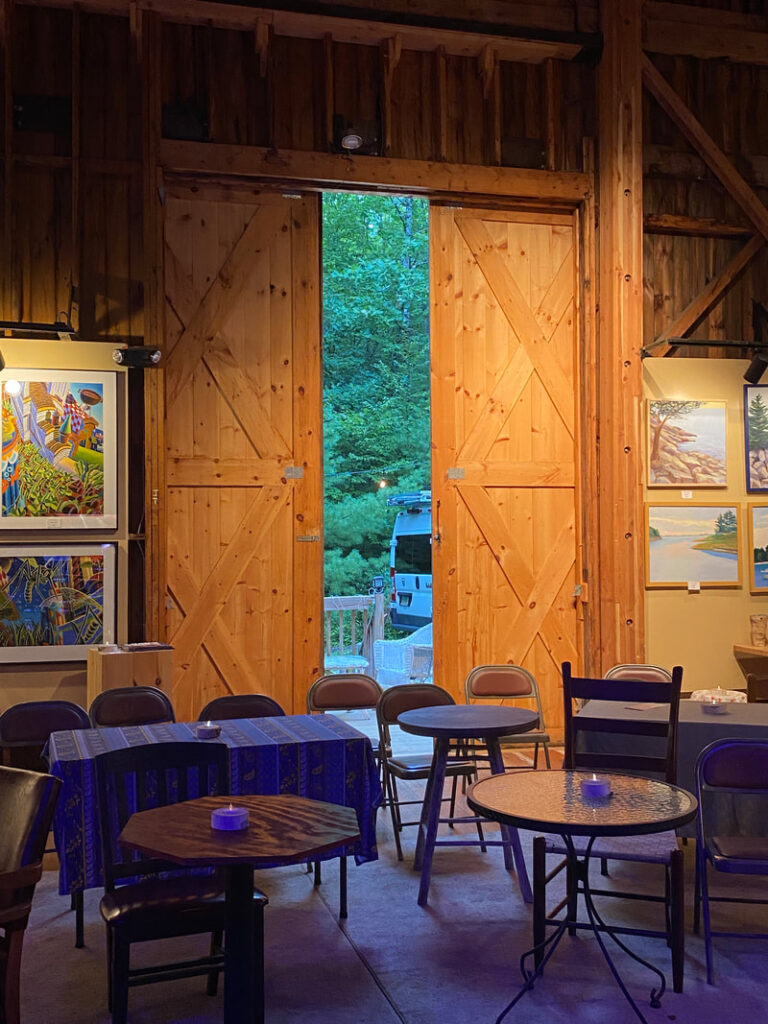
A former opera singer herself, as well as producer and director of opera, Dillon saw the property she had purchased on Dawes Hill, high above Harrison’s lakeside village, as an ideal environment where artists could develop their artistic abilities through practical stage experience. To this end, Dillon hired Harrison G. Wiseman, a famous theatre architect, in 1933 to design the most technically perfect opera theatre possible. Three years later, the theatre was built by Bridgton builder George Locke, using rose hemlock harvested on site. Its near-perfect acoustics and, at the time, a state-of-the-art lighting system impressed artists and audiences alike. Two large 15-foot-square mechanical doors along the backstage wall were a unique feature of the theatre. When the doors were slid open, the forest behind the theatre was visible during performances.
Opening Night 1936
Deertrees Gala Opening
Deertrees Theatre’s Gala opening was on August 15, 1936. That evening, “America’s Greatest Actor,” Walter Hampden, delivered a special program of dramatic readings from his famous plays to an overflow audience. Three additional concerts followed during that first summer.
1939 Poster
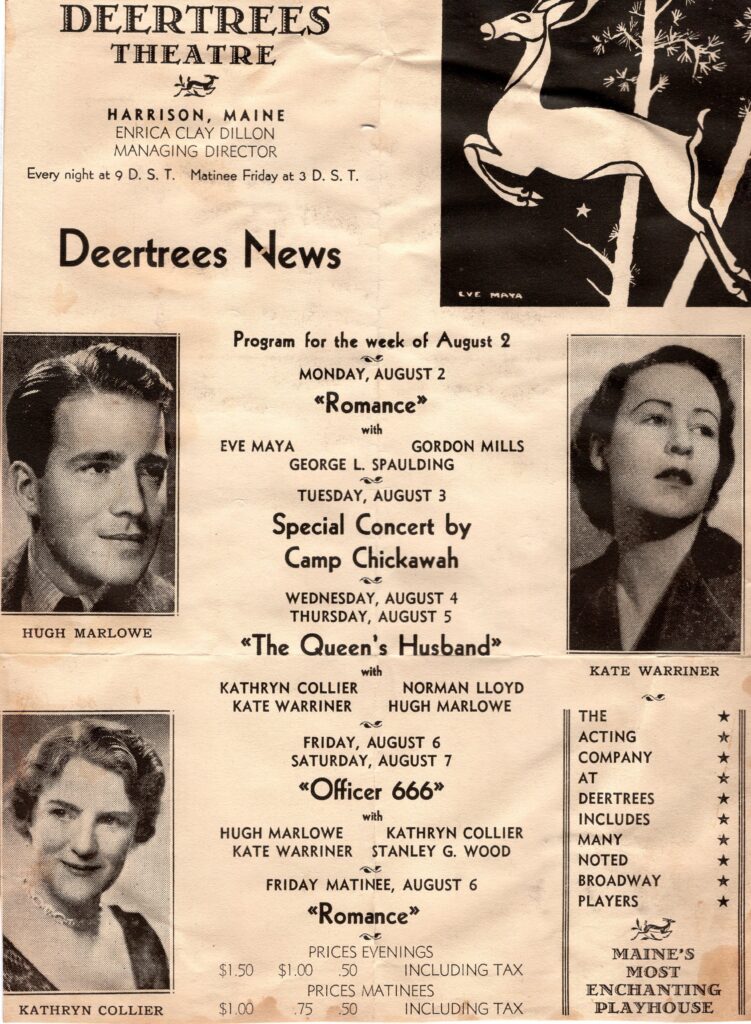
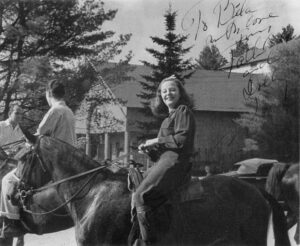
For the 1937 summer season, Dillon assembled a repertory company of known and unknown actors to perform four different plays in rotation from late June through mid-August, followed by a musical comedy. Among the known actors were Lowell Gilmore, Hugh Marlowe, Kate Warriner, and Kathryn Collier. Among the unknown was Norman Lloyd, who went on to have a successful career past the age of 100. The youngest member of the company was twenty-year-old Dorothy McGuire.
1937 Poster
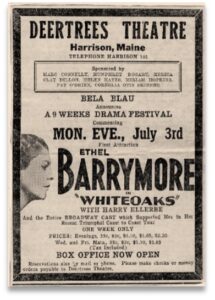
Deertrees Theatre remained dark for the summer of 1938, but reopened in 1939. This time, New York producer Bela Blau had leased Deertrees. He planned a nine-week drama festival to bring Broadway shows to Harrison under the banner of “A New Play – A New Broadway Star Every Week.” Sponsors for the festival included Humphrey Bogart, Helen Hayes, Miriam Hopkins, Pat O’Brien, Cornelia Otis Skinner, Rudy Vallee, Marc Connelly, and Enrica Clay Dillon.
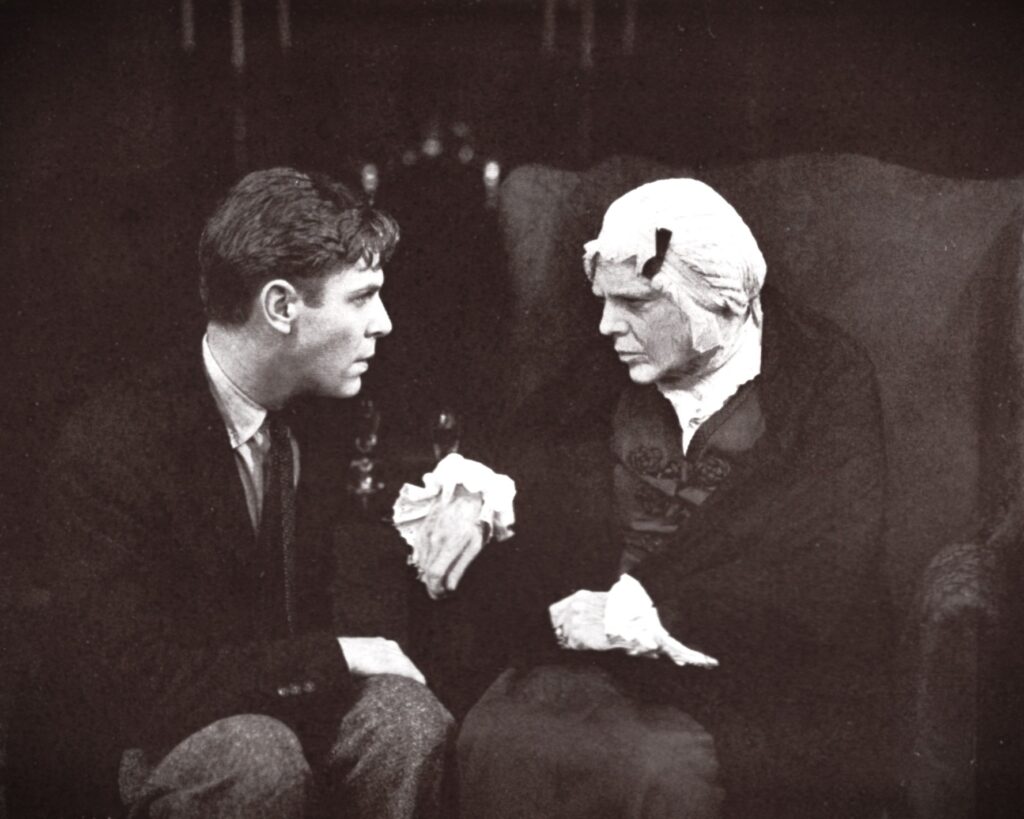
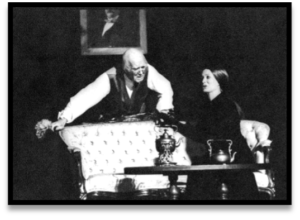
Finch and Barrymore in Whiteoaks in 1939
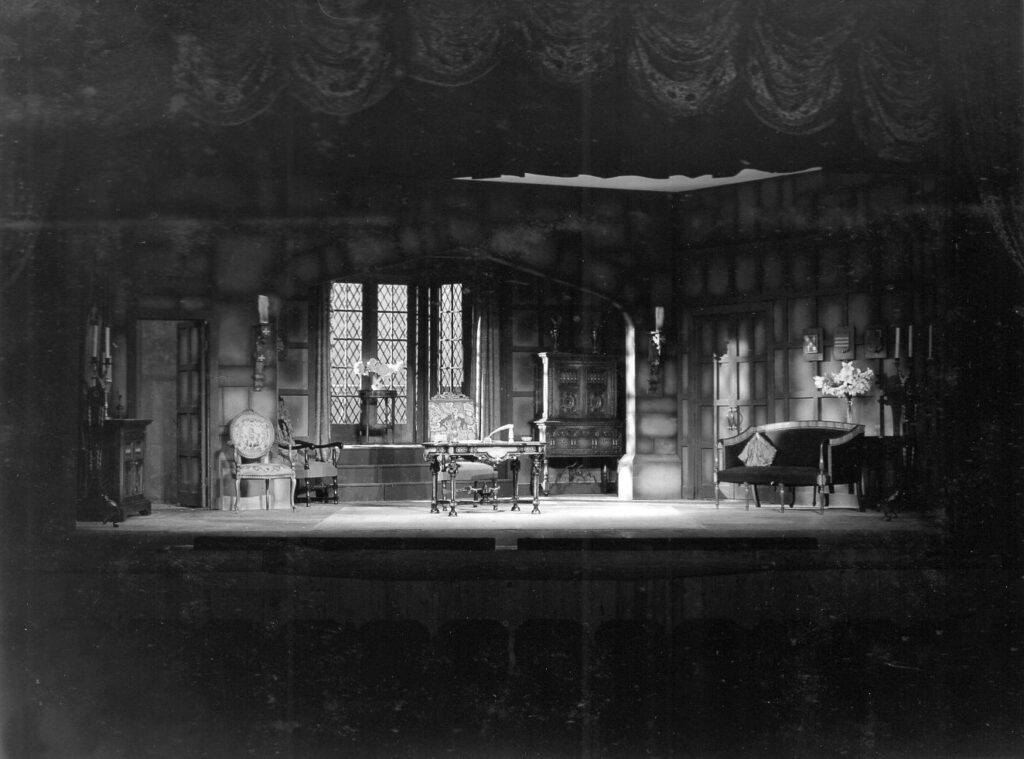
1939 Set for Viceroy Sarah starring Dame May Whitty
Blau’s first season was impressive even by contemporary standards. Ethel Barrymore opened the festival. Helen Claire, Edward Everett Horton, Elissa Landi, Edith King, Madge Evans, Dame May Whitty, Rudy Vallee, and Jane Cowl, all well-known stage, motion picture, and radio performers at the time, followed. Working for Blau that first year at Deertrees were future Tony Award-winning producer David Merrick; Vivian Vance, best known as Ethel on the I Love Lucy television sitcom; and Phyllis Thaxter, who went on to a forty-year career in motion pictures and television.
Tallulah Bankhead, 1940
Barrymore returned to open the 1940 season, followed by Tallulah Bankhead, Grace George, Arthur Treacher, Joe E. Brown, Ruth Chatterton, and Florence Reed in signature performances. It was after the 1940 summer season at Deertrees that Dorothy McGuire and Reta Shaw went on to star on Broadway and in motion pictures.
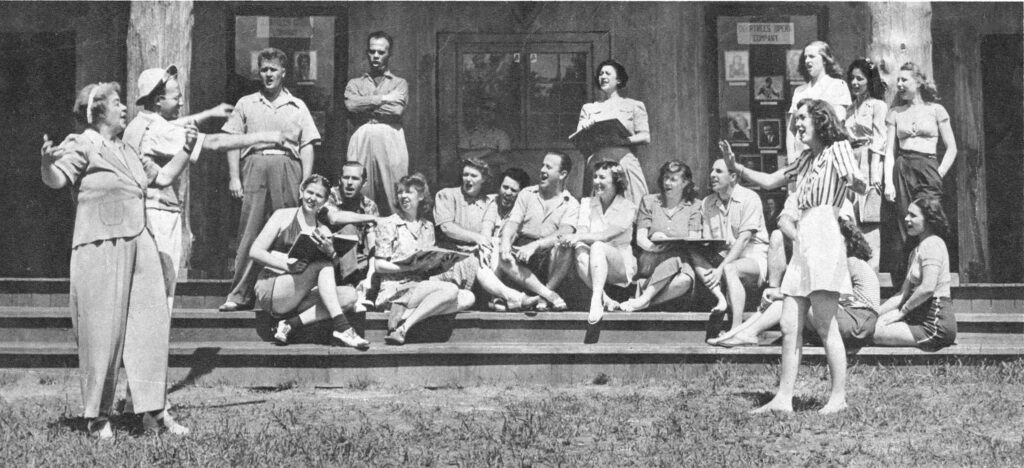
Enrica Dillon with her pupils in 1941
After returning to New York at the end of his second successful season at Deertrees, Bela Blau suddenly died of a heart attack at the age of 44. This unexpected turn of events prompted Dillon to return to the helm of Deertrees in 1941. But this time, she focused entirely on training future opera singers and left the play productions to The Barnstormers from Tamworth, New Hampshire. stage experience. To this end, Dillon hired Harrison G. Wiseman, a famous theatre architect, in 1933 to design the most technically perfect opera theatre possible. Three years later, the theatre was built by Bridgton builder George Locke, using rose hemlock harvested on site. Its near-perfect acoustics and, at the time, a state-of-the-art lighting system impressed artists and audiences alike. Two large 15-foot-square mechanical doors along the backstage wall were a unique feature of the theatre. When the doors were slid open, the forest behind the theatre was visible during performances.
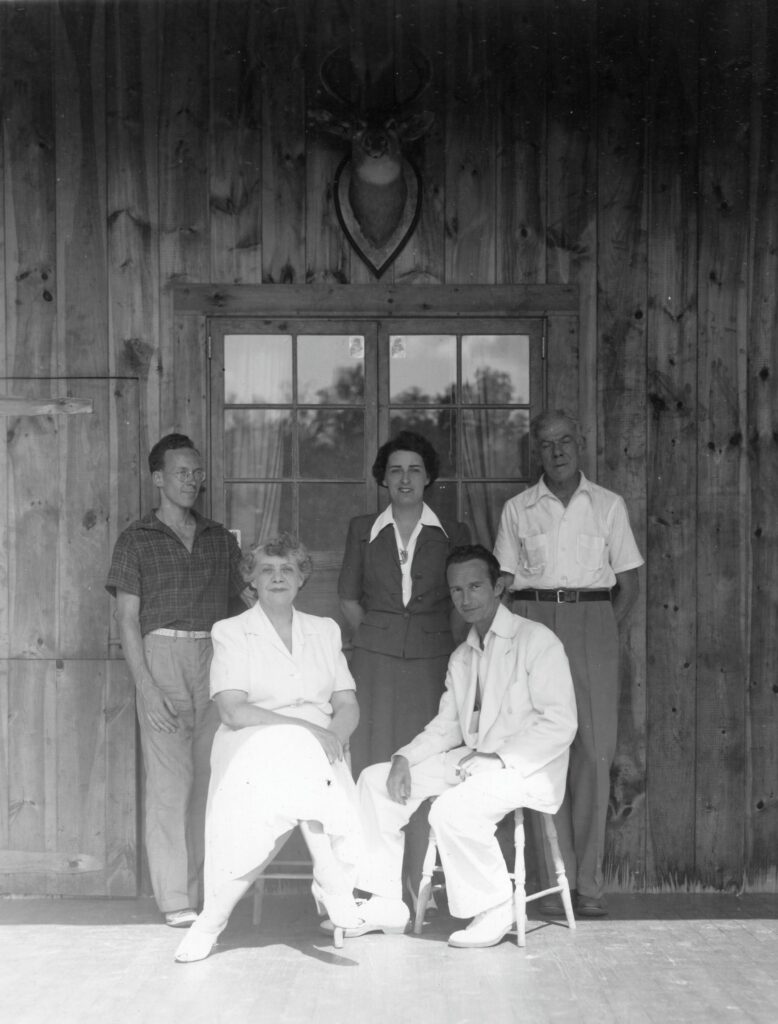
Enrica Dillon (seated) with her staff in 1942
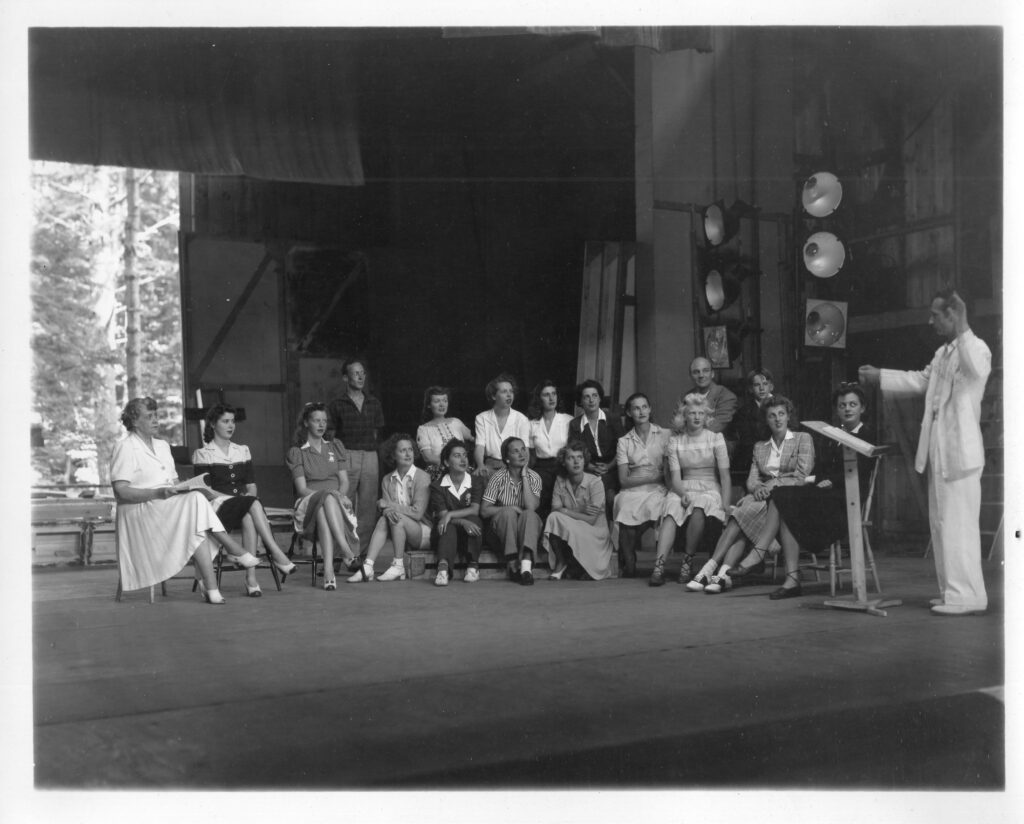
Enrica Dillon and conductor Igor Bouryanine with summer pupils in 1942
Impact of Word War II
Because of the impact of World War II, Dillon ran the eight-week opera training school in 1942, but staged only two performances. After that, Tallulah Bankhead, 1940 Enrica Dillon with her pupils in 1941 Deertrees Theatre in the 1940s Enrica Dillon (seated) with her staff in 1942 Enrica Dillon and conductor Igor Bouryanine with summer pupils in 1942 Deertrees remained closed except for an occasional recital until the summer of 1946. Due to failing health, Dillon’s last year at Deertrees was 1946. She had formed Deertrees Players to perform three plays and a musical. The pupils in her summer opera program did a concert every Sunday afternoon and closed the season performing Cosi Fan Tutte. Dillon died in October of 1946 at the age of 68.
Deertrees Theatre in the 1940s
Deertrees was left dark until it was sold in 1949 to New York attorney A. L. Sainer and his partner, New York realtor Samuel Wolf. Sainer hired his son-in-law, Robert Harris, as Deertrees’ managing director. Their banner was “No stars. Just good shows.” For two consecutive summers, they successfully presented ten plays featuring Equity players in their resident acting company. The theatre then went back on the market in 1951.
Deertrees in 1949
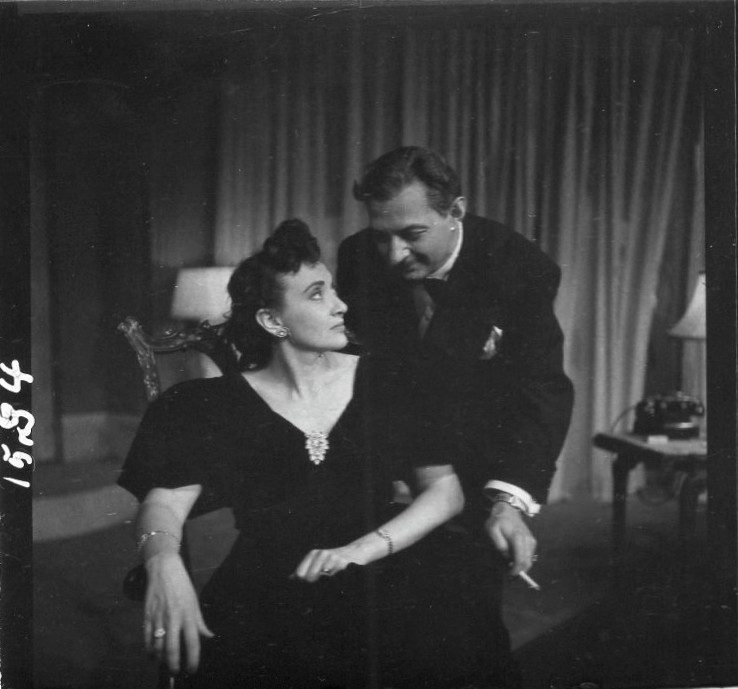
Viola and Robert Harris in Portrait in Black in 1950
The Keiths bought Quelchaque on Long Lake to house visiting community theatre players
Harvey, performed in 1954 by The Community Players from Pawtucket, Rhode Island
Deertrees Reopens
Sherwood Keith, founder of Boothbay Playhouse, purchased Deertrees in 1953. He reopened Deertrees in 1954 and, for two summers, presented a weekly offering of plays performed by outstanding community theatre groups from across New England. One of the college interns working at the theatre in 1953 was Russell Morash. Morash went on to become a highly successful television producer and director for WGBH TV, winning 14 Emmy Awards for shows such as The French Chef with Julia Child and This Old House with host Kevin O’Connor.
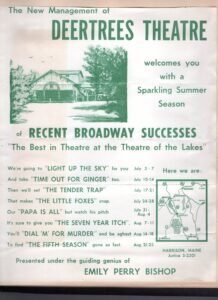
When Keith retired in 1956, Aya Sholley purchased Deertrees. She hired Emily Perry Bishop to be the director. Sponsors included actresses Bette Davis, Jane Wyatt, Betty Field, Ruth Roman, Jeannette MacDonald, and Cornelia Otis Skinner; as well as actors Robert Montgomery, Fred Waring, and John Carradine; singer-comedian Sophie Tucker; and playwrights Moss Hart, Howard Lindsay, and Elmer Rice.
Together, Bishop and Sholly ran the theatre for four summers with a talented resident acting company. Then Deertrees went dark again for the next two years.
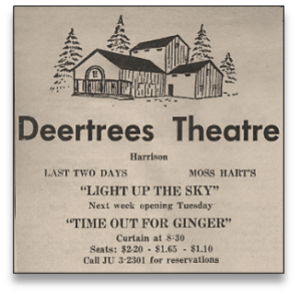
1956 Poster
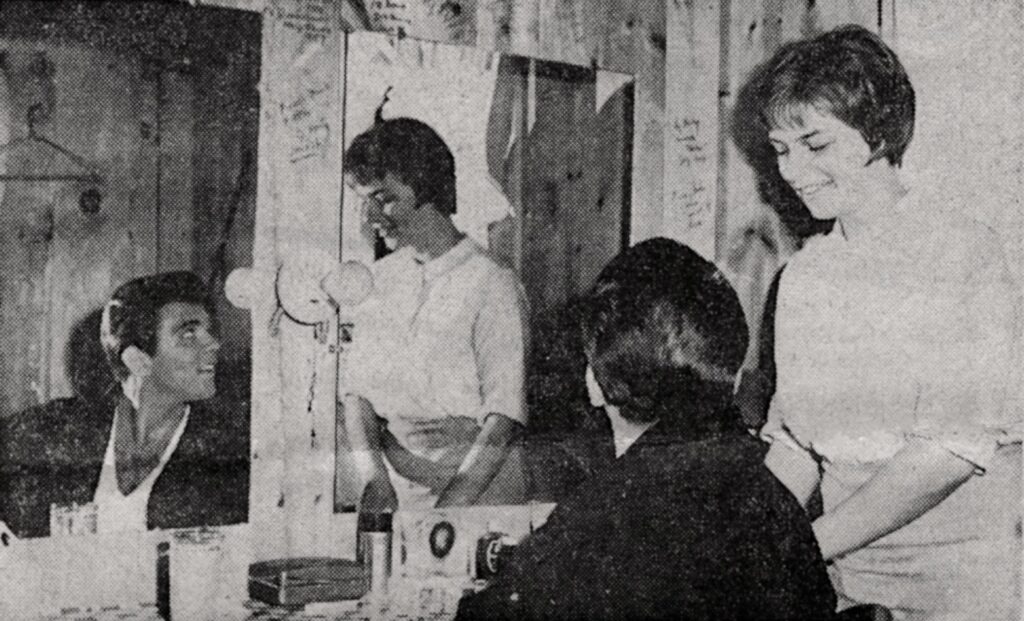
Fabian at Deertrees in 1962
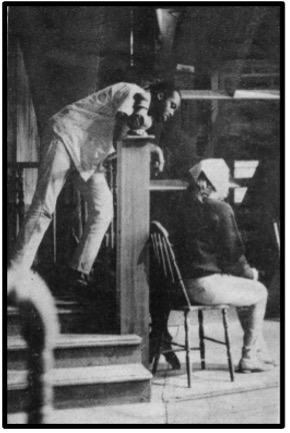
Bill Duke (left) and Frankie Tucker in Look Back in Anger in 1965
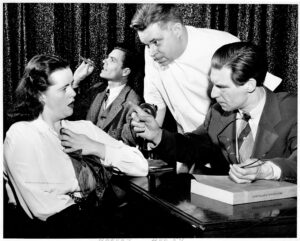
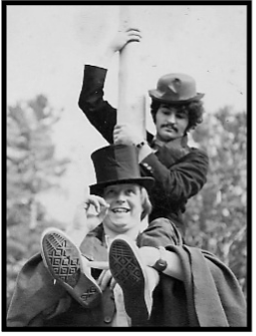
Paul Kreppel (top) with Ken Farrell, 1969
Riverside Theatre, Inc., owned by Edward Dangel and Samuel Lebovitz, took over Deertrees for the summer of 1962. It was a season of celebrity headliners, including Ann B. Davis, Shirley Knight, teen-idol Fabian, Lee Philips, Jill Corey, Mark Richman, and Allen Case.
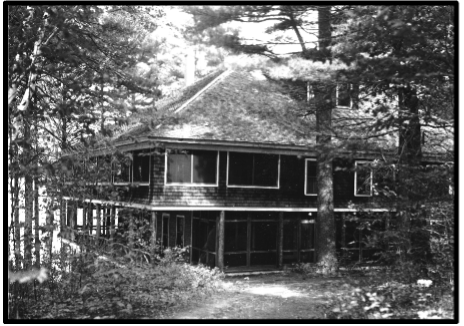
Deertrees reverted back to Aya Sholley in 1963. Again, the theatre remained dark until Sholley gifted it to Emerson College in 1965 to be used as a summer training center for theater students. The college then purchased the former boys’ camp adjacent to the theatre’s property to use as a campus for its Emerson College Performing Arts Center program.
For the next four summers, young college students enrolled in the Emerson College Performing Arts Center program at Deertrees participated in all aspects of theatre. Several of the students went on to highly successful acting careers after appearing on Deertrees’ stage. They included Frankie Tacker, Bill Duke, Ron McLarty, and Andrea Martin.
In 1969, Emerson student David Maturi bought Deertrees from the college for $9,000 and founded the Coventry Theatrical Community. The acting company presented two exciting seasons of light comedy and musical shows, featuring dinner-and-theater specials with local restaurants. Ceci Hart and Paul Kreppel were two of the company members who went on to stardom after performing at Deertrees. Unfortunately, rapidly rising costs led to the company folding in 1971.
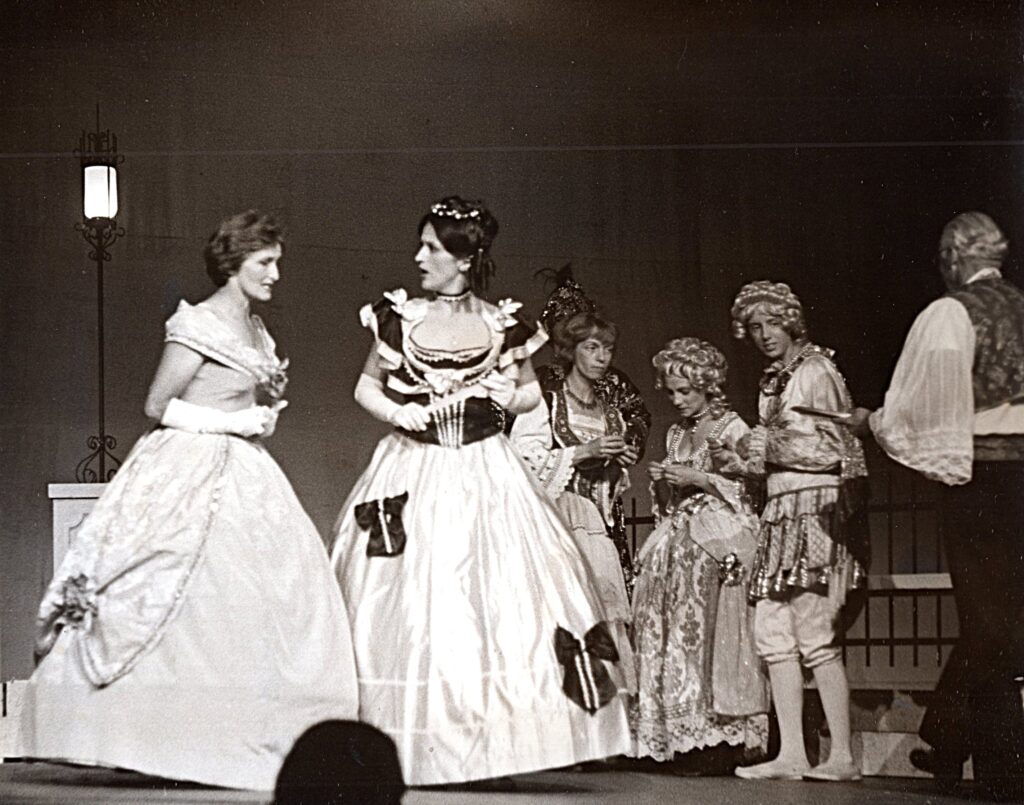
M’Lou Terry (left) and Carol Toscano (center) in the 1976 production of Die Fledermaus
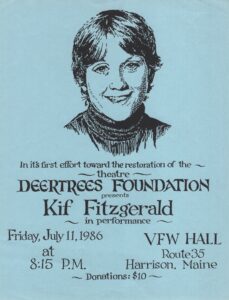
1986 fundraiser poster
Deertrees is Sold
Maturi eventually sold the property to Judith and Donald Ritter in November 1974. The Ritters promoted two resident companies: one for opera productions and the other for experimental theater. But after 1979, the theater went dark again, a victim of the 1970s gas crisis and weak revenues.
By the 1980s, the building had fallen into serious disrepair, and porcupines were the only visitors. The town of Harrison had gained title to the property in lieu of unpaid taxes. At one point, there was talk of using the building for a fire department training exercise.
Under the leadership of Dr. Allan Mills, a group of concerned citizens formed a nonprofit foundation to save the theater and recreate the climate in which Deertrees could once again thrive. Appearing at Deertrees Foundation’s first fundraiser in 1986 was 13-year-old Christopher “Kif” Fitzgerald, a child actor from Portland, Maine, who years later became an award-winning Broadway star.
At first, performances were staged on the theater’s front porch because the building was considered unsafe for occupancy. By the early 1990s, enough repairs had been made to allow the theatre’s stage to be used once again.
1993 The Marriage Proposal starring Michael Bradshaw and Sarah Boberg
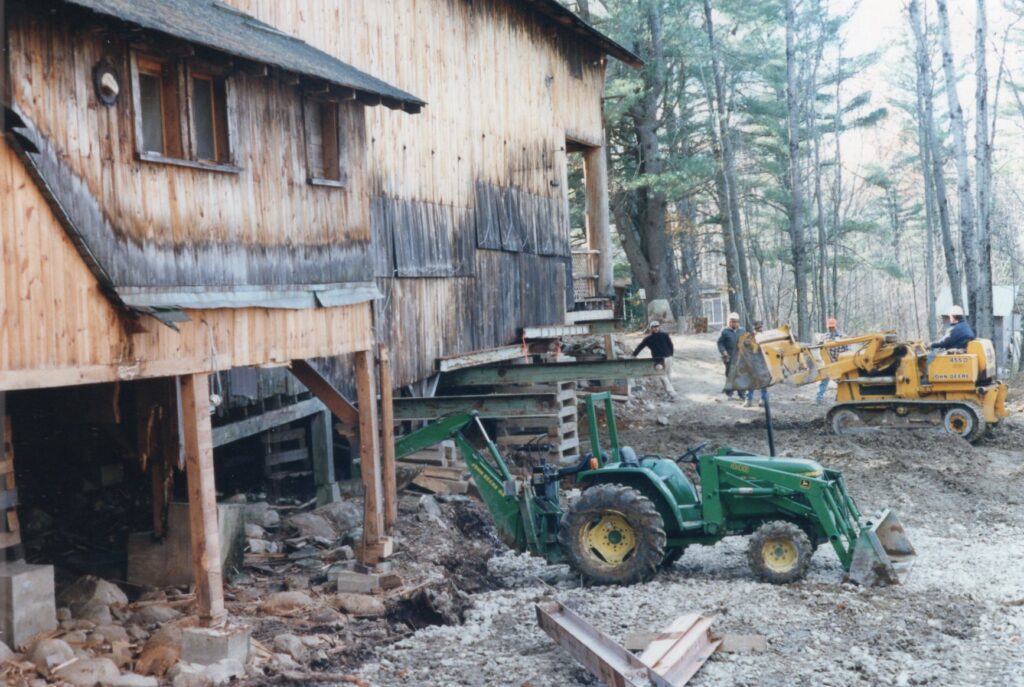
1997 restoration
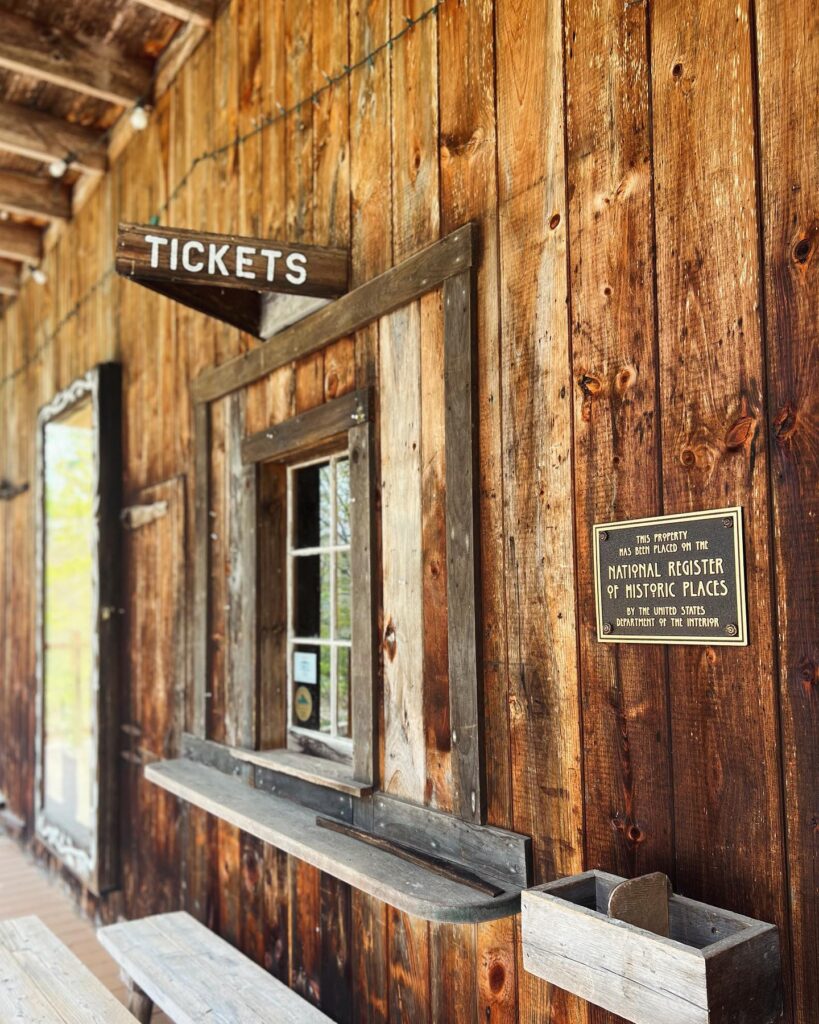
Box Office Window
The Restoration of Deertrees
The major restoration project to install a foundation under the theatre began in 1997 and was completed in 1998. The theatre’s annex, referred to as the “ell”, was stabilized in 2007. Then in 2020, permanent restrooms replaced temporary restrooms, and a winterized office space was created.
In 1999, the Town of Harrison deeded the theater to the Deertrees Foundation, Ltd. The nonprofit corporation’s name was changed in 2014 to Deertrees Theatre, Ltd.
Now listed on the National Registry of Historic Places and self-funded by box office receipts, grants, and an annual capital campaign, Deertrees is run as a nonprofit theater presenting a variety of performances during a season that runs from late June to early September. It’s all made possible by a legion of committed volunteers from the local community, generous donors and sponsors, talented artists who love performing at Deertrees, and loyal audiences.
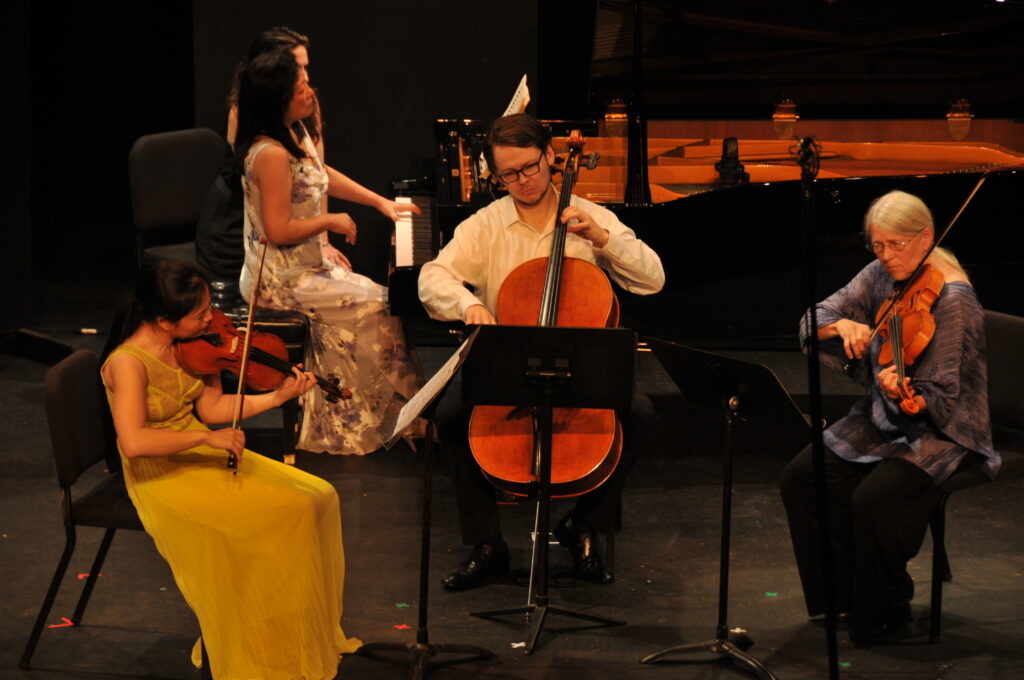
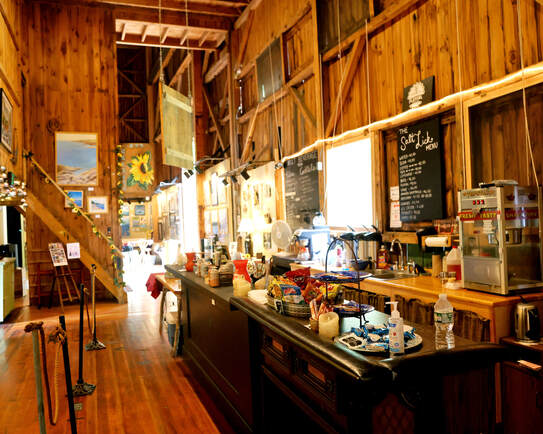
As home to the Sebago Long Lake Music Festival (SLLMF), the Backstage Gallery, and the Salt Lick Cafe, the magic of Deertrees continues to enchant artists and audiences alike.
Sebago-Long Lake Music Festival
Salt Lick Cafe
Deertrees Theatre 2019
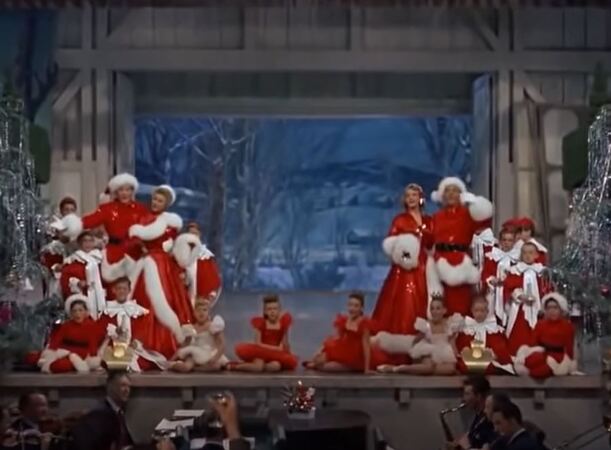
Doors featured the film "White Christmas"
The "White Christmas Doors" today
Have you seen our "White Christmas" doors?
ISee the doors onstage in the classic 1954 film White Christmas? These are the same back doors at Deertrees Theatre! Come down to take a look.